JESUS FINCH
JESUS FINCH BY TOM MILNER
The enigmatic ‘Jesus’ Finch is a legend within Birmingham’s homeless community. Preacher, oddball and regular police target, he keeps to himself. Until one day, when the narrator helps Jesus reconnect with an old flame and discovers he may or may not have once been in a relationship with a pop star. The judges described Jesus Finch as ‘an electric story full of narrative propulsion, energy and strong characterisation’.
You can read the story below.
TOM MILNER
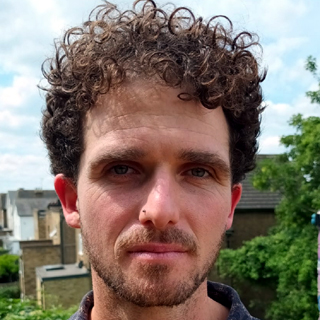
Tom Milner is a groundworker by day and a novelist by night. His work focuses on the intertwining relationships of so-called ordinary people, shining a light on those who, either by chance or circumstance, live in the shadows of society. He’s a member of Writing West Midlands’ Room 204 programme.

Jesus Finch
The first time I saw Jesus he was running through New Street Station with his trousers round his ankles, spanking his bare arse and yelling about God knows what. With two police officers chasing him, the whole thing reminded me of Scooby-Doo. It even had the cartoon ending: Jesus zapped with a taser, flapping like a beached fish as white foam frothed out of his mouth.
I’d heard rumours about him way before that. Ghost stories told at soup kitchens and huddled around a lighter flame in the darkest alleyways. Some claimed he was from the future, that he was over three hundred years old, that his hair grew sideways, or that he was secretly a millionaire playing homeless as some kind of performance art.
After that first time, I started seeing him everywhere. At Pigeon Park and the soup kitchen on Colmore Row; outside shelters and the kebab shops that gave us leftovers at closing time. I saw him in the streets, preaching his sermons, shouting to anyone close enough to hear. It was those public lectures that earned him his nickname.
Everything I knew about Jesus had been attached to him without his consent; sticky weeds of gossip wrapped around his body, so tangled he’d stopped trying to wriggle free. He didn’t ask for money or help. No one ever saw him sleep. He wasn’t friends with anyone. He never took drugs or sold them. He didn’t look people in the eye. He never said anything unless he was shouting it, wading into traffic, not stopping until the police came or he lost patience.
‘WHAT YOU DON’T UNDERSTAND,’ I heard him scream once – he was outside the Bullring, trousers round his ankles, being led away by security guards – ‘IS THE PRICE YOU PAY FOR THE THINGS YOU DO.’
I’d tried to speak to him a few times before that, mostly at the soup kitchens when the charity girls refused me an extra slice of crusty bread until I’d introduced myself. He never said a word, though. His eyes stayed shark-black as he stared ahead, focused only on the pocket of empty space ahead of him.
It was a few weeks later when we finally spoke. I was begging my way around town, outside of TK Maxx and All Bar One, near the tunnel by the side entrance to the Bullring. If that street’s got a name, I don’t know it. In the middle of that road there’s an advertising board, one that scrolls infinitely down like a phone screen. Standing underneath it, screaming and crying and attracting attention, was Jesus.
It didn’t make sense at first. On the screen was an advert for Coventry University, happy students sitting on grass. Jesus banged his fists against them, his throat gargling with phlegm as he looked up to the empty, grey sky and wailed until he could wail no more. The advert scrolled away, replaced by a new Nintendo games console. Super Mario leaping for joy as Jesus bowed his head to him, going, ‘NOOO! BRING HER BACK, MAKE HER COME BACK. YOU CAN’T DO THIS.’
Two police officers on the far side of the road had been alerted. I went to the crossing and waited for the traffic to ease. Buses and cars roared past, close enough for the puddles to splash up my legs. Trains ran endlessly in and out of the station, vibrating the ground beneath my feet. You don’t realise how relentless the world is until you need it to shut up and go away. Jesus seemed somehow both oblivious to all the noise and tormented by it.
‘BRING IT BACK! BRING HER BACK! YOU CAN’T DO THIS TO ME, YOU CAN’T… IT AIN’T FAIR, IT AIN’T RIGHT, IT AIN’T … FAIR … WE MADE LOVE! WE MADE LOVE … IT AIN’T FAIR.’
I stood by his side. He was a good two inches taller than me, but his body slumped forward like a too-full bin bag. Looking at Jesus reminded me of forgotten things worn down by constant use: stone steps in castles, collapsed trees in forests, rust on the underside of boats.
‘You alright, mate?’ I said. ‘I’m Finch. Harry Finch. I dunno if you’ve seen me around …’
He didn’t answer or look up until the advert changed. Persil replaced H&M’s summer range. Jesus raised his head and let out a broken, tired moan. Tears made streams down his dusty cheeks. ‘Mate,’ I said, ‘come on, the police are watching. Chill out a bit.’
The advert switched to a pop star’s tour poster. A girl’s face leaned out of the shadows, huge and smiling. Below her chin was a list of dates and locations. London to Birmingham to Nottingham to Manchester, on and on for the rest of the year. Jesus shouted again and fell forward, trying to speak with his mouth smooshed against the screen.
‘I can’t hear ya, mate. Sorry.’
Above the girl’s head it said OLIVIA KING in bold white letters. I put a hand on Jesus’ back, let it rest there as he sobbed.
‘Do you know her, or something?’
Jesus looked up, drool hanging like icicles from his lips. Sucking it back in, he said, ‘She’s the love of my life and I’m the love of hers.’ The screen went back to Coventry University. ‘We’re supposed to be together.’
Across the street were the police officers, two intimidating blokes hiding their hands in their stab vests, faces shadowed by their little hats.
‘I want to go.’ Jesus lifted his head. The police waited for a gap in traffic to cross. I put my hand up, begging them to stay put. The road was a nightmare; an endless current of hoarse, grumbling cars, their tyres slicking through puddles. It was getting to me as much as it was Jesus. He looked to the sky and the endless traffic, the mossy kerbs and the potholed tarmac, seeing the ugliness of the world he lived in. I could see his brain unravelling, his final threads coming loose.
‘I want to go,’ he said. ‘I need to go.’
‘I’m sorry, mate. It’s alright. Let’s go.’
For some reason he listened to me. His teeth were yellow and broken, snapped in half like old fence posts. His lips were cracked the same way his skin was. His hair was short and fuzzy, littered with string and fluff. Patches of scalp showed through, as if he’d gone at it with scissors. We crossed the road and arrived by the side of a building, where we put our backs to the glass and slid down until our bums hit the ground.
The advertising board scrolled through its selection. Persil, Nintendo, Coventry University, a new Sony TV, a Tommy Hilfiger watch, and eventually Olivia King’s tour poster. Jesus pointed at it, at her.
‘We made love and no one believes me, no one listens to me,’ he said. ‘She’s a star, a shining star and I always knew it. Now look where she is and look where I am.’
‘Really?’ I couldn’t think of anything else to say. He didn’t answer, just carried on ranting.
‘I mean wow look at Olivia … not King though her last name ain’t King … but that’s Olivia, alright, and we’ve made love, we’ve done the whole thing and planned our lives together…see, I knew she was a big shining star from the moment I first saw her, I did, I did, and anyone else who knows her would say the same thing.’ He stopped for a second, carried on nodding. ‘But no one else knew her like I did, I can promise you that … oh yes I can … I’ll do that here and now or over there and later … yes yes … oh yes.’
I didn’t believe him. Jesus spoke a lot of rubbish, all of it public and none of it logical. Jesus saying he knew this Olivia bird, some big famous pop star, he may as well have been saying he could fly. But telling him to shut up with his delusions didn’t feel like the right option. He was clearly upset, and the police were still watching him like he was on a ledge threatening to jump. And, honestly, I liked Jesus. I wanted the best for him. He was weird. I thought knowing him would shine some light on my own dull life, so I played along.
‘You really knew her?’
He nodded, closed his eyes.
‘How do you know it’s her if she’s changed her name?’
With his eyes still closed, he said, ‘It’s the same face that’s been in all my dreams, all of them, every single one.’
She came on the screen again. Jesus opened his eyes and closed them, trying to squint the pain away.
‘And you’ve slept with her?’
His eyes squeezing into thin creases, he said, ‘So many times.’
I don’t know what I was thinking, really. I don’t know why the thought crossed my mind, or what I imagined could ever come from it, but I left Jesus sitting against the glass, crossed the road, stood under the advert and waited for Olivia King to come back. I looked at her tour dates, the venues. And believe it or not, she had a show on that very day, at the O2 Institute in Digbeth. A ten-minute walk from where we were. So I thought, What’s the worst that could happen? We’d have a walk down to Digbeth, have a chat. Jesus would have something to believe in, something to look forward to, for probably the first time in years, and it was better than hanging around the train station begging for change. Nothing would happen. There’d be bouncers, and locked doors.
I sat down beside him and said, ‘I’ve got an idea.’
***
Jesus didn’t take much convincing. The two police officers came over and asked us to move on, despite agreeing that things had calmed down. I started walking to Digbeth, Jesus following a few paces behind. He’d wander into shops and hair salons, banks and restaurants, only to get shooed back out like a stray dog. He’d sit on kerbs, in the middle of paths and roads, refusing to move until traffic ground to halt. Then he’d run off celebrating, not grasping that it was his wailing, flailing body making the cars stop and not his telekinesis.
We didn’t talk much. I think he forgot I was there, and what we were supposed to be doing. His eyes were wide open, bordering on manic. His pockets were full of pamphlets and twigs; I know because he kept emptying them. Trainers flapped off his feet like sandals. His sleeves were cut so his thumbs could poke out of slats in the cotton. Despite the heat, he was layered like a pass-the-parcel. Jackets on top of jackets on top of jumpers on top of shirts. I saw at least two pairs of trousers. Jogging bottoms under his jeans. Two belts.
Somehow we reached the O2 Institute. Doubts were creeping in about why I’d led him there. After all, Jesus was a man who claimed to have unbreakable teeth, who screamed it at the top of his lungs in the middle of the street, who wanted the whole world to know his toes were longer than his fingers.
‘We’re here,’ I said.
Jesus shook his head. ‘This ain’t the right place.’
‘I think it is, mate.’
‘Nope.’
‘Do you want to just leave it?’ I asked, not having a clue what I wanted him to say.
He shook his head.
‘What time is it?’
Jesus was still shaking his head when he said, ‘None of our business what the time is.’
‘Right. I’m asking because she might already be here. They come early to do soundchecks and that, don’t they.’
Jesus didn’t answer, so I said, ‘Come on, let’s just knock on the door. What’s the worst that could happen?’
‘Erm, well, I don’t know, Harry. Maybe the door could blow up? All that wood could splinter your face and your legs and your ears, your testes … the hinge could flip off and spark everywhere and cut your throat and your testes and … or a bad person could be in there. Some freaky so-and-so, some not-nice person who shouts at us and tells us to go away. Tell us to leave and to never come back, and honestly, whatever your name is, I don’t need to be told by anyone else to shoo away or to get out of their face and away from their business because I’m making a scene. Maybe you’ve got enough of that bad shit, those drugs, those liquids and powders in you to handle it, but I ain’t … I am clean as a whistle.’
‘I’m not … I’m not on any drugs,’ I said, which was actually true. Due to a financial issue I was as clean as I’d been in weeks. ‘Look,’ I said, ‘the gate’s open. Obviously there’s people here. We’ll find someone official, tell them you’re an old friend.’
‘Yes, you do do drugs. I seen you do them.’
‘Okay,’ I said, ‘can we focus on what we’re doing, please?’
‘I don’t like it.’
‘Tough. We’re going in.’
The O2 was a fairly uninteresting place, built in blood-orange brick with mouldy concrete around the windows and doors. The bottom half was like a nightclub, blacked-out glass covered with Olivia King posters, while the top half had tried and failed to resemble a castle; the towers on either side like sad ice cream cones. The main entrance was its grandest feature, framed by pillars and lorded over by a stone-cut Digbeth crest. The door, usually guarded by steel gates, had been left slightly open and didn’t so much as squeak as we snuck our way in.
We heard the over-there sound of a vacuum cleaner. The muffled noise of instruments tapping, thumping, twanging, tuning up.
‘This is bad,’ Jesus said. ‘We shouldn’t be here. This is illegal.’
‘This coming from the bloke who runs around Birmingham with his dick out?’
Jesus said nothing. He followed me in. I shouted Hello: nothing. We went to the bottom of the stairs and shouted Hello again: nothing. My voice echoed, floating off into the far corners of the ceiling. Marble staircases framed each side of the room. A set of double doors was between them, closed and locked.
‘No one’s here,’ Jesus said. ‘Let’s go, we should go, this is really wrong. I don’t know you and you don’t know me and this is bad. She won’t be happy to see me.’
‘What makes you say that?’ I asked, a foot on the first step.
‘Because no one ever is.’
We took every step as if tip-toeing on a frozen lake, expecting the marble to crack and shatter, for the floor to swallow us whole. Most buildings are off-limits to the homeless. We sneak in for the toilet or to get away from the rain, but barely reach the stairs before we’re ushered back outside.
‘The hoover’s stopped,’ Jesus said.
‘No it hasn’t.’
‘It might’ve.’
‘Will you stop being a wuss? Let’s try this door.’
‘This is a baaaaad idea,’ Jesus said. ‘I don’t even know what to say to her, it might not even be her.’
I’d already climbed the stairs and reached the doors, opening them onto the second-floor balcony. There were workers and cleaners between the seats, hoovering the floors and litter-picking.
We reached the edge of the balcony and looked down to the stage. A whole band was there: a drummer tss-tss-tssing a cymbal; a guitarist plucking her strings; a bassist tuning up as a girl, instantly recognisable as Olivia King, floated between them. It was her frizzy black hair and pearly-white smile, the air of a star she carried herself with, as if she was exactly where she was born to be. In her hands a microphone, its black wire laced through her fingers and trailing behind her.
‘Look,’ I said. ‘It’s her.’
Jesus grabbed the edge of the balcony, first leaning back before lunging forwards, his face throbbing with veins and sweat as he let out a wild, deranged yell. The workers came running over. The music stopped as every face was suddenly on us. Footsteps came rushing up the stairs as a man appeared in the doorway, taller and wider than us two combined, eyes only for the lunatics who’d broken into his theatre. He made a straight charge for Jesus.
‘OLIVIAAAAA!!’ Getting tackled to the ground, Jesus shouted, ‘WE MADE LOOOOOOVEEEE!’
And from somewhere out of the ether, in the hollow box of the theatre, came a fuzz from a microphone; a high-pitched tone as a mouth pressed to its grille and said, ‘Joe?’
Other shortlisted stories:




The Brunel Prize Winner
Rowan is a poet and tree surgeon living in East London. His work has recently been featured in 14 Magazine and Acumen. His poem ‘Wild Ghazal’ won second prize in the Shelley Memorial Project’s 2025 competition. He is currently working on a new pamphlet of compromised, radical ecopoems.